Posted on 26th November 2026
Portland stone is the limestone of St Paul's Cathedral and Buckingham Palace, and it is still quarried on the same few square miles of Dorset today. This guide explains what Portland stone is and where it comes from, its place in British architecture, the Heritage Portland range we supply with Albion Stone, where walling, bricks, quoins and copings are each used, how the stone weathers, and how to work with it.
Portland stone at a glance
- What it is: an oolitic limestone formed around 150 million years ago in a shallow Jurassic sea.
- Where it comes from: the Isle of Portland, a tied island off the Dorset coast, and nowhere else.
- Colour: white to cream, lightening rather than dulling as it weathers.
- Compressive strength: averaging 47.97 megapascals, with water absorption of 5.85 per cent.
- Standards: CE certified with a declaration of performance, frost tested to BS EN 12371, A1 fire rated.
- Best known for: St Paul's Cathedral, Buckingham Palace, the Bank of England and the Cenotaph.
What is Portland stone and where does it come from?
Portland stone is an oolitic limestone laid down around 150 million years ago in a warm, shallow Jurassic sea. Tiny grains of calcium carbonate rolled on the seabed around shell fragments and compacted into a fine, even stone, white to cream in colour, with the shells still visible in its surface and body.
The amount of shell varies through the beds. The Whitbed is the cleaner, more uniform stone, and the Stonehills Whitbed we supply has a limited shell content, while Heritage Portland shows the full range of the stone's natural geology.
It comes from one place, the Isle of Portland, a tied island off the Dorset coast. It was quarried there for centuries in open pits; today much of it is mined, leaving the landscape above undisturbed. Every piece of Portland stone we sell is produced by Albion Stone, a long-established Portland producer that extracts and manufactures the stone from its own quarries and mines on the island.
Portland stone in British architecture
Few building materials carry as much history. After the Great Fire of London, Christopher Wren chose Portland stone for St Paul's Cathedral, and it became the stone of the British establishment: Buckingham Palace, the Bank of England, the British Museum, the Cenotaph and thousands of civic and commercial buildings across the country.
It was chosen because it cuts cleanly, carves finely and, above all, endures. Three centuries after Wren, the same beds are still being worked, which is why Portland remains the only honest match for repairs to the buildings it made.
The Heritage Portland range and our work with Albion Stone
We supply Portland stone direct from Albion Stone, cutting out the distributor so that a stone once reserved for prestigious cladding is available for garden walls and restoration at a competitive price.
Every product is CE certified with a declaration of performance and can be traced to its source. The bricks and setts carry full technical data: a compressive strength averaging 47.97 megapascals, water absorption of 5.85 per cent, frost testing to BS EN 12371 and an A1 fire rating, produced under an ISO 9001 quality system.
Portland stone walling, bricks, quoins and copings
Random walling
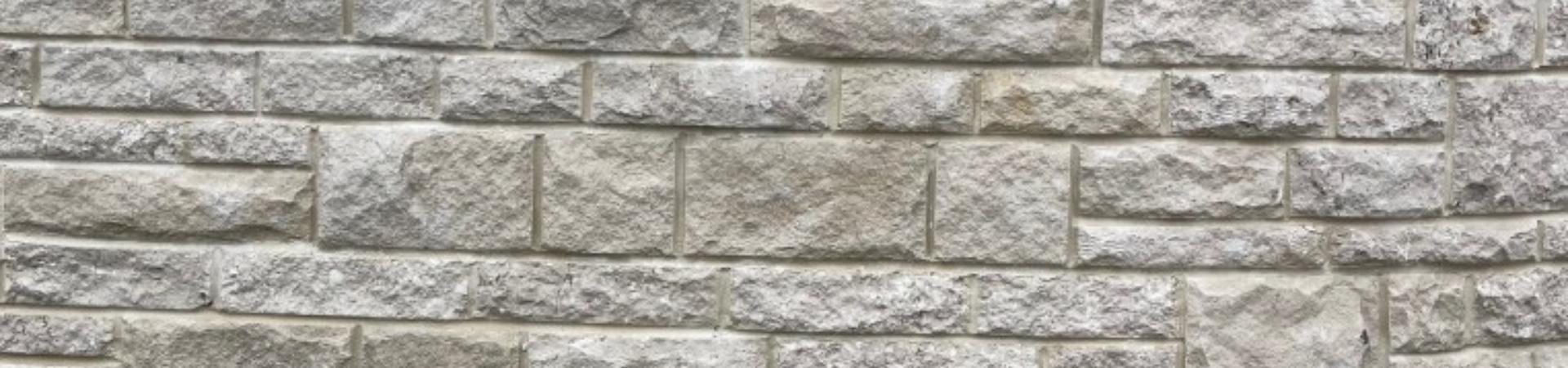
Heritage Portland random walling is hand-selected limestone in lengths of 250 to 450mm and heights from 50 to 250mm, processed to a nominal 100mm bed depth, with around five square metres to a 950kg pallet. It gives the traditional, informal face of a Dorset garden wall and is the most affordable Portland walling per square metre.
Coursed walling
Coursed Portland is cut to consistent heights of 50 to 150mm with random lengths, and Royal Heritage Portland is split-faced in 65, 140 and 215mm courses that tie into standard blockwork heights. Consistent heights reduce sorting and cutting on site and suit formal boundary walls and contemporary schemes.
Bricks, setts and slips
Heritage Portland stone bricks are sawn on all six sides to the standard 215 x 102 x 65mm, with no frog, to a tolerance of plus or minus 2mm under BS EN 771-6. They lay like a brick and read as dressed stone, the choice for extensions, garden buildings and matching existing Portland. The same block cut as a 20mm slip clads an existing wall, and as a sett it paves paths, patios and drives.
Quoins, copings and sills
Portland quoins, split-faced in 220 and 440mm lengths at 215mm high, define external corners and should be planned in from the first course. Portland copings, 300mm wide in random lengths at 40mm thick, cap the wall and shed water; drip grooves are cut on request. Sills, heads and lintels are made to measure, typically within three weeks.
How does Portland stone weather?
Portland stone is unusual among limestones in that it lightens with age rather than dulling. Rain washes the exposed faces clean, so the stone whitens over the decades while sheltered areas under sills and copings stay darker. This is the pattern visible on every Portland building in London, and it is a characteristic of the stone rather than a fault.
The stone is frost resistant, hard-wearing and low maintenance. It does not need sealing in normal garden use, and the only care most walls need is to keep pressure washers and de-icing salt away from the face.
How do you build with Portland stone?
Portland cuts cleanly with a diamond blade and takes a sharp arris, but order five to ten per cent extra for site cutting and spares.
- Footings: build on a concrete strip footing roughly 100mm wider than the wall on each side.
- Backing: for a faced wall, back the stone with 100mm block up to 450mm high, and 140mm block up to 1.2m.
- Bedding: bed the stone on a full mortar bed and keep the joints neat and consistent.
- Mortar: use a lime-based mortar on heritage and conservation work, and a standard 3:1 sand and cement mix for modern garden walls.
- Bricks and setts: lay butt-jointed or with a 3 to 5mm joint.
- Copings: set to overhang both faces so water is thrown clear of the wall.
Why lime mortar matters on older buildings
On heritage and conservation work, a lime-based mortar is the traditional choice because it stays softer than the stone and lets the wall breathe. Moisture escapes through the joint rather than through the face of the stone, so the mortar weathers before the masonry does and can be replaced without damaging the original fabric. A hard cement mortar traps moisture and forces it out through the stone, which causes spalling over time. For modern garden walls in Portland, a standard 3:1 sand and cement mix is appropriate.
Portland stone for conservation, repair and restoration
Much of the trade interest in Portland stone sits in conservation. Because the same stone has been used for centuries, new Heritage Portland matches the original fabric of listed buildings, boundary walls and memorials in a way no substitute can.
Bricks and quoins allow piecing-in repairs. Made-to-measure sills, heads and lintels replace weathered originals. Brick slips and ashlar panels reface structures where full-depth stone is not possible.
Free samples are available on all Portland products, and bespoke masonry quotes are on 0330 1280776.
Frequently asked questions
What kind of stone is Portland stone?
Portland stone is an oolitic limestone, formed around 150 million years ago from grains of calcium carbonate that compacted around shell fragments on a shallow Jurassic seabed. It is fine, even-grained and white to cream in colour, with shell fragments visible in the surface.
What colour is Portland stone?
Portland stone is white to cream when freshly cut. Unusually among limestones it lightens with age rather than dulling, because rain washes the exposed faces clean, so a weathered Portland building whitens over the decades while sheltered areas under sills and copings stay darker.
Where does Portland stone come from?
Portland stone comes from the Isle of Portland, a tied island off the Dorset coast, and nowhere else. It has been quarried there for centuries in open pits, and much of it is now mined, which leaves the landscape above undisturbed.
What stone is St Paul's Cathedral made of?
St Paul's Cathedral is built of Portland stone. Christopher Wren chose it after the Great Fire of London, and that decision made Portland the stone of the British establishment, used afterwards for Buckingham Palace, the Bank of England, the British Museum and the Cenotaph.
Is Portland stone good for garden walls?
Yes. Portland is frost resistant, hard-wearing and low maintenance, with a compressive strength averaging 47.97 megapascals. Buying direct from the quarry has brought a stone once reserved for prestigious cladding within reach for garden walling, bricks, quoins and copings.
Does Portland stone need sealing?
No. Portland stone does not need sealing in normal garden use. It is naturally frost resistant and weathers well. Keep pressure washers and de-icing salt away from the face, and most walls need no other care.
What mortar should I use with Portland stone?
Use a lime-based mortar on heritage and conservation work, because it stays softer than the stone and lets the wall breathe. For modern garden walls, a standard 3:1 sand and cement mix is appropriate. Keep joints neat and consistent either way.
Can Portland stone be used to match an existing building?
Yes, and this is one of its main advantages. Because the same beds have been worked for centuries, new Heritage Portland matches the original fabric of listed buildings, boundary walls and memorials in a way no substitute stone can. Bricks and quoins suit piecing-in repairs, and sills, heads and lintels are made to measure.
How much Portland walling do I need?
Heritage Portland random walling covers around five square metres per 950kg pallet at a nominal 100mm bed depth. Measure the face area of the wall in square metres, divide by the pallet coverage, and add five to ten per cent for site cutting and spares.